


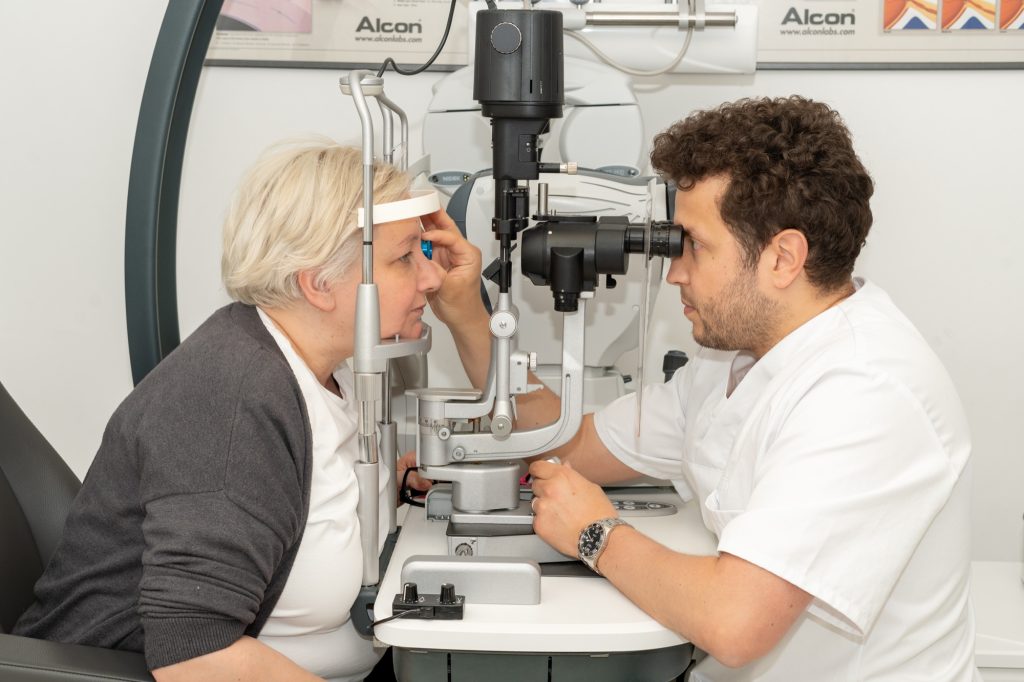
The eye is the only transparent organ in the body. The ophthalmological examination provides information about the patient’s vision and general state of health.
When should you see an ophthalmologist?
It is advisable to consult your ophthalmologist every year, especially :
- People whose work is hard on the eyes (computers…);
- People with diabetes or high blood pressure;
- People with a family history of glaucoma.
Sometimes, certain tests must be performed in addition to the standard consultation. Here are just a few examples:
- In young children with suspected strabismus: search for amblyopia (poor vision in one eye), examination under medicated cycloplegia (accommodation blockage), examination of binocular vision and stereoscopy, fundus examination to look for an organic cause;
- In school-age children: check for ametropia and/or monitor its progress, examine binocular vision, color vision, stereoscopy, fundus examination;
- In adults in their forties: look for ametropia, both near and far, systematic eye tone measurement, fundus examination;
- In adults over sixty: look for changes in media transparency, ocular hypertonia and age-related abnormalities in the macular zone.
- People with neurological problems: Neuro-ophthalmology is a vast clinical and scientific discipline that covers both the sensory aspect of vision and its inseparable oculomotor support.
- People with retinal pathologies (see retinal surgery)
Consultation prices
| Type of consultation | Consultation price | Mutuelle reimbursement | BIM reimbursement |
|---|---|---|---|
| Adult | 80€ | 37,54€ | 47,89€ |
| Children aged 7 to 17 | 85€ | 56,71€ | 77,44€ |
| Children under 7 | 90€ | 67,84€ | 84,57€ |
| Driver’s exam | 121€ | Not refundable! | No refund ! |