


What is refractive surgery?
A discipline of ophthalmic surgery, refractive surgery aims to correct optical refractive defects of the eye:
- myopia,
- astigmatism
- hyperopia
The aim is to eliminate the need to wear glasses or contact lenses to correct vision.
Refractive surgery involves sculpting the cornea in order to modify its radius of curvature in the center and periphery, homogeneously or not, and thus increase or reduce its optical power. This reshaping of the cornea is carried out using a special laser (the excimer laser). It emits an ultraviolet beam whose energy, absorbed by the cornea, enables photoablation (vaporization of corneal tissue) down to the micron. This technique, the most commonly used, can be used to correct :
- myopia: the eye is too long, so the image is formed too much in front of the retina, and the person sees blurred at a distance. In refractive surgery, we use lasers to reduce the curvature (and therefore the optical power) of the cornea;
- hyperopia: the eye is too short and/or the cornea is too flat. The plane of the sharp image is behind the retina, so the image formed on the retina is enlarged and the person has blurred near vision. Surgery will increase the curvature of the cornea;
- astigmatism: the eye’s refractive power varies according to the meridians of the cornea, resulting in blurred vision depending on the axis, both far and near. The laser is used to regularize the surface of the cornea.
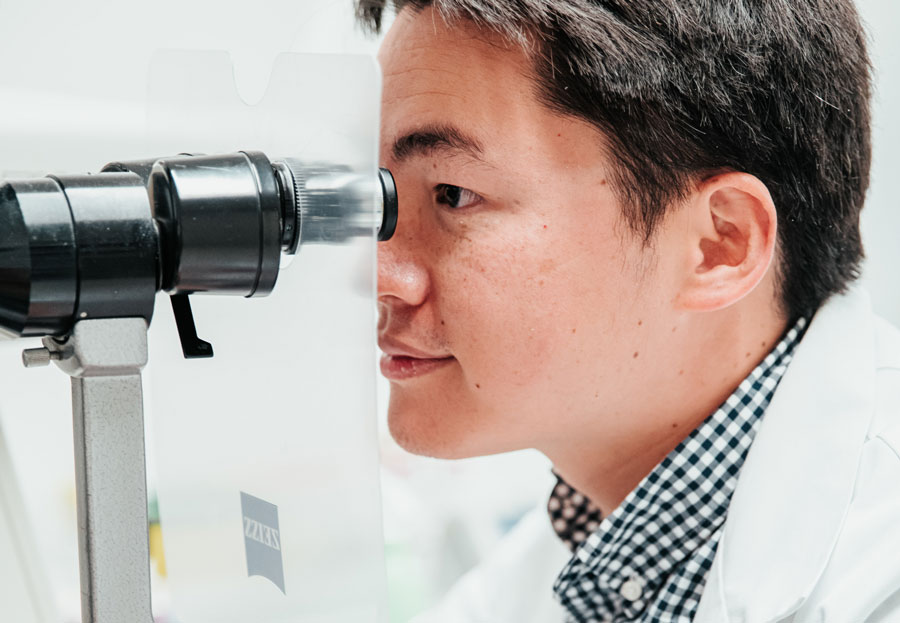
The excimer laser can be used in two different ways
The laser is used directly on the surface of the cornea, a few microns thick, after removing the epithelium with a small brush.
The correction is delivered to the superficial stroma, just below the epithelium.
This technique can be used for mild to moderate myopia. It is particularly recommended for people with thin or irregular corneas, or with certain anomalies (scars, etc.).
We create a “superficial corneal flap” before directly sculpting the corneal stroma, at greater depth than with PRK.
In practice, a small flap is cut on the surface of the cornea using a femtosecond laser (a laser that works with extremely short pulses, of the order of a femtosecond).
The flap is lifted and the cornea sculpted using an excimer laser.
The corneal flap is then replaced.
No sutures are needed; it will heal on its own. Lasik is particularly suitable for hyperopia.
How does refractive surgery work?
Patients should not wear contact lenses for at least 48 hours prior to surgery, to ensure that the ocular surface is not irritated on the day of surgery.
The operation is performed by a surgeon specially trained in refractive surgery techniques. Generally, both eyes are operated on in a single operation (bilateral surgery).
Refractive surgery is performed on an outpatient basis, under local anesthetic (eye drops), possibly supplemented by a mild tranquilizer. The procedure is painless. The patient lies down, and a special device called a blepharostat is fitted to hold the eyelids apart. During the procedure, the patient stares at a spot of light.
When should refractive surgery be performed?
Refractive surgery can correct certain myopias, hyperopias and astigmatisms. It is the patient who expresses the wish to undergo refractive surgery, but not everyone can be operated on, as there are certain selection criteria. A pre-operative assessment is therefore necessary to check whether the patient is eligible for refractive surgery.
It is made up of various elements:
- Examinations: refractive examination (to characterize and measure the extent of the eye's optical defect), corneal topography (to assess the regularity of the cornea), pachymetry (measurement of corneal thickness), pupillometry, ORA (Ocular Response Analyzer) measurement, depending on the patient. The aim is to detect any problems that might contraindicate refractive surgery, such as keratoconus (deformation of the cornea, which gradually thins to take on the shape of an irregular cone), or cataracts. Some severe visual defects are also ineligible for refractive surgery.
- A medical examination concerning all pathologies, ophthalmic or otherwise, and surgical history, particularly refractive surgery.
Refractive surgery cannot be performed on patients who are too young, as their vision must have been stable for at least a year.
This assessment also helps determine which technique is best suited to the patient (between PRK and Lasik, for example).